




The Moment the Story Changed
Alex Braman will tell you that Greenlight’s customers handed him his biggest strategic challenge without knowing it. Parents who had trusted Greenlight with their children’s spending were coming back with a different kind of question. Not “how do I set a spending limit?” but “how do I know where my kid is right now?” They weren’t asking for a better financial product. They were asking Greenlight to solve the next problem in their lives because they already trusted the company with the first one.
That shift, from a company known for a debit card for kids to something that might be called a family technology platform, is the defining challenge Alex is working through today as the CMO of Greenlight. It raises a question that sits at the heart of modern growth marketing: when your product is expanding beyond the category that made you, how do you tell a new story without abandoning the one that built your audience?
“How do we take ‘the debit card for families’ and move it toward a financial and technology platform for families?” Alex said. “We’re thinking through how we communicate that. It’s still a little clunky, so we’re working on it.”
That honesty is characteristic. Alex is not a marketer who reaches for polished language when the work is still in progress.
Meet Alex, Meet Greenlight
Alex stumbled into marketing. His career started in management consulting, building decks for large companies trying to allocate their resources more wisely. He was good at structured thinking and getting ideas to land with skeptical audiences. But marketing came later, almost by accident, and when it did, it stuck because of what he calls the immediate feedback loop.
“With digital, you could test and learn immediately,” he said. “Do truck owners like a picture of a truck on an ad for their mortgage? Turns out, no, they don’t. But they react well when you give them a big number.”
That combination, analytical rigor from consulting and empirical curiosity from early performance work, is still how he operates. He thinks about internal alignment the way a consultant thinks about client management: you have an idea, you know it might face resistance, so you build your case, pressure-test it with data, and get the right people on board before the big meeting. That skill, which he describes as “shepherding and growing ideas until everyone buys in,” translates directly to running a marketing organization where spending decisions require sustained conviction across multiple quarters.
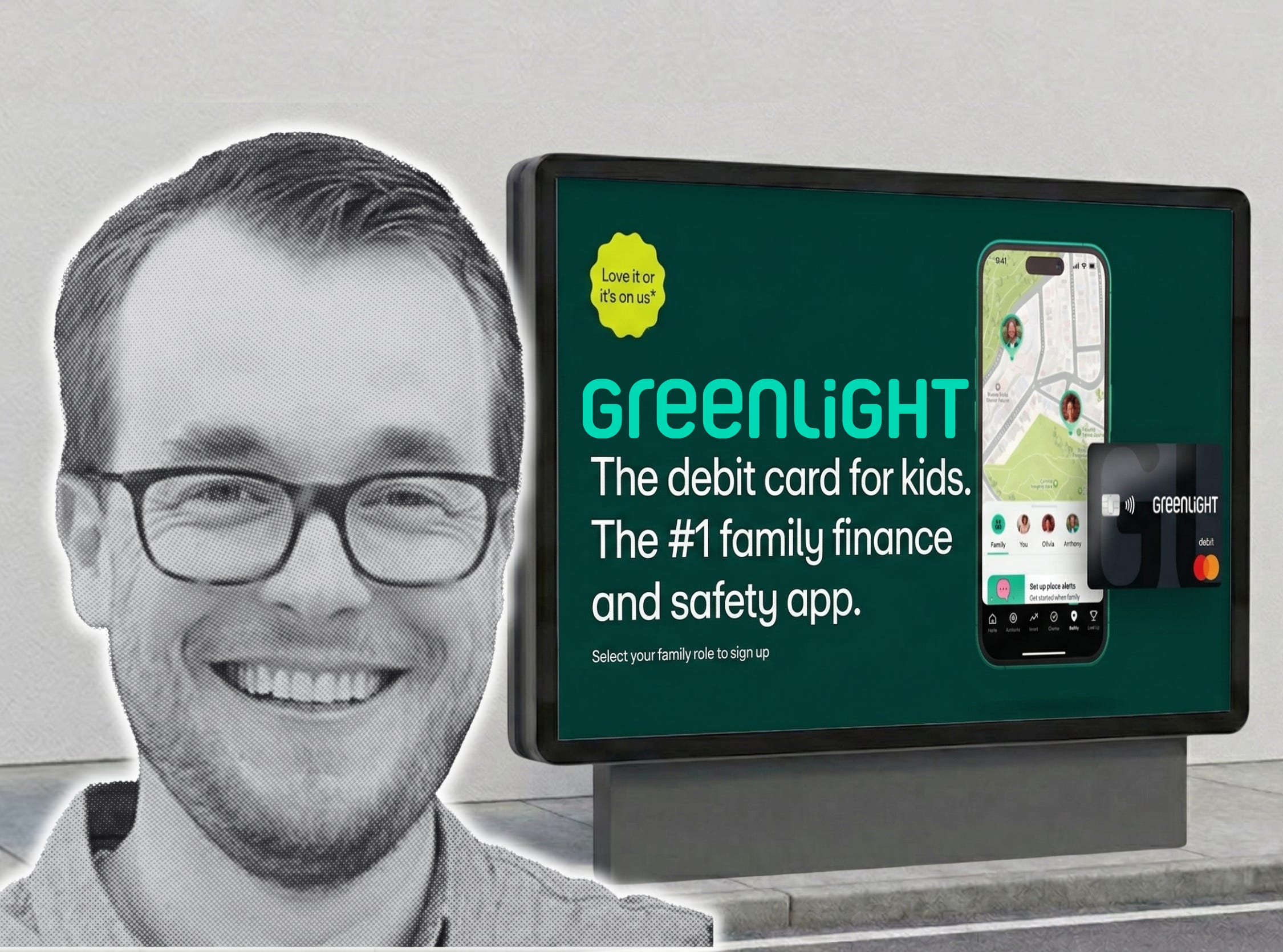
Greenlight, based in Atlanta, offers a debit card and financial platform for children and their parents. Kids get spending controls, chore-linked allowances, a 6% savings rate on the premium tier, and access to educational investment products. Parents get visibility, guardrails, and something harder to name: confidence that they are teaching their children something real about money. More recently, Greenlight has added family location tracking and driving alerts, products that extend the platform into what Alex describes as “a family tech suite that is finance-enabled.”
The trust barrier Greenlight is working against is not skepticism about the product. It is category awareness. Most parents do not think they need a specialized financial platform. They assume the problem is manageable without one, right up until the moment their child wants to spend freely on a family vacation or buy items in a gaming app without a ceiling. Greenlight’s marketing job is to make that moment feel familiar before it happens.

The Engine: Growth in a Noisy Media Environment
Alex runs a media mix that covers paid social, search, display, TV, audio, podcasts, and Reddit. Each channel plays a different role, and he thinks carefully about which channels can serve two purposes at once.
“TV is compelling because you can do direct response and awareness with it,” he said. “And audio is relatively cheap, so you can figure out a way to still get those impressions.” Reddit has become a more deliberate part of the mix, not as a conversion driver but as a top-of-funnel tool. “It’s more like how do you start a conversation with someone for our business,” he said.
On Meta, the team is building analytical models to process creative metadata and flag when the algorithm’s performance starts to shift. The goal is to move from reactive diagnosis to predictive monitoring, using AI to surface patterns in the ad library that would take a human analyst weeks to find manually.
The most interesting growth challenge Alex described is the one every scaling company eventually faces: you’ve captured the people who were already looking for you, and now you need to find the people who don’t know they should be. His approach is demographic and behavioral gap analysis. If women in a certain age range convert strongly through Facebook but men in a comparable range convert better through live events, that difference tells you something about where your awareness problem lives, not just your conversion problem.
“Who should be using your product but isn’t?” he asked. “When you look at persona data or demographic data, you usually will find out that some segment loves you, but another doesn’t, even though the product is good for both.”
Solving that incrementally means protecting an idea long enough to measure whether it worked, which brings him back to the consulting skill set. Getting buy-in for a long-cycle awareness investment requires the same internal storytelling discipline as presenting an unpopular recommendation to a Fortune 500 client.
The Craft: Brand and Performance Are the Same Function
Alex does not separate brand from growth, and he is direct about why.
“If you’re putting a direct response ad out there, it’s still your brand,” he said. “Growth is going to be brand and performance together.”
He owns both at Greenlight, and that structural choice reflects a philosophy: every dollar in the market should serve the dual purpose of telling people who you are and telling specific people why they need you right now. When those two goals operate in separate silos, the creative drifts, and the story becomes incoherent.
The category pivot from fintech to family tech is making that philosophy harder to execute and more important to get right. The new positioning needs to feel earned, not declared. “We need the product to be able to deliver on these promises so that they feel progress from their use of the product, or they feel joy from their kid learning about money,” he said.
That combination of functional value and emotional payoff is what Alex means when he talks about storytelling. A good storyteller, he argues, can entertain, educate, or motivate. A great one can do all three without losing the audience before the arc lands. His example of Liquid Death, a water brand that led people to believe they were buying something edgier than it was, is instructive. The product did not change. The story changed reality around it.
The Road Ahead: Fewer Steps, Sharper Inputs
Alex’s view on AI in marketing is less about what the tools can do today and more about where the leverage will be in 12 to 24 months. He believes the middle steps of campaign production, channel allocation, landing page builds, and creative formatting are already being compressed. What remains irreplaceable is the upstream judgment: what do you stand for, who are you talking to, and why does your story earn attention in a crowded market?
“The execution and solid campaign management, recommending which channel does what, what broke with your pixel, that’s going to be a lot easier to solve soon,” he said. “The remaining extremely valuable talent is nailing the competitive positioning and owning that.”
For his own team, that changes what he looks for in a hire. Process fluency matters less than the instinct to break the process and find a better outcome. A person who has figured out five ways the system fails and rebuilt it each time will always outperform someone who can describe the system accurately. The difference is more obvious now because the tools can handle the description.
Building the Category From the Customer Up
What Greenlight is doing in 2026 is not a brand refresh. It is a category construction project, and the brief came from customers. Parents who trusted the platform with their children’s money started asking it to solve adjacent problems, such as location tracking, schedule management, and the general anxiety of raising kids in a connected world. That trust, built transaction by transaction on the financial product, became the permission structure for something broader.
Alex’s job is to translate that expansion into language that feels natural rather than overreaching. The category Greenlight wants to own, family tech, does not fully exist yet in the way consumers think about it. Defining it, in product, in marketing, and in the story the brand tells every time it runs an ad, is the work of this year and probably the next several.
“Long-term, the category we want to be in and we’re defining is what family tech is,” he said. “What’s the suite of products for a family? And we’re very excited about that.”
The debit card was the beginning. The rest of the story is still being written.
More from Uncovered Media


