

Andrea Leewong - Parafin
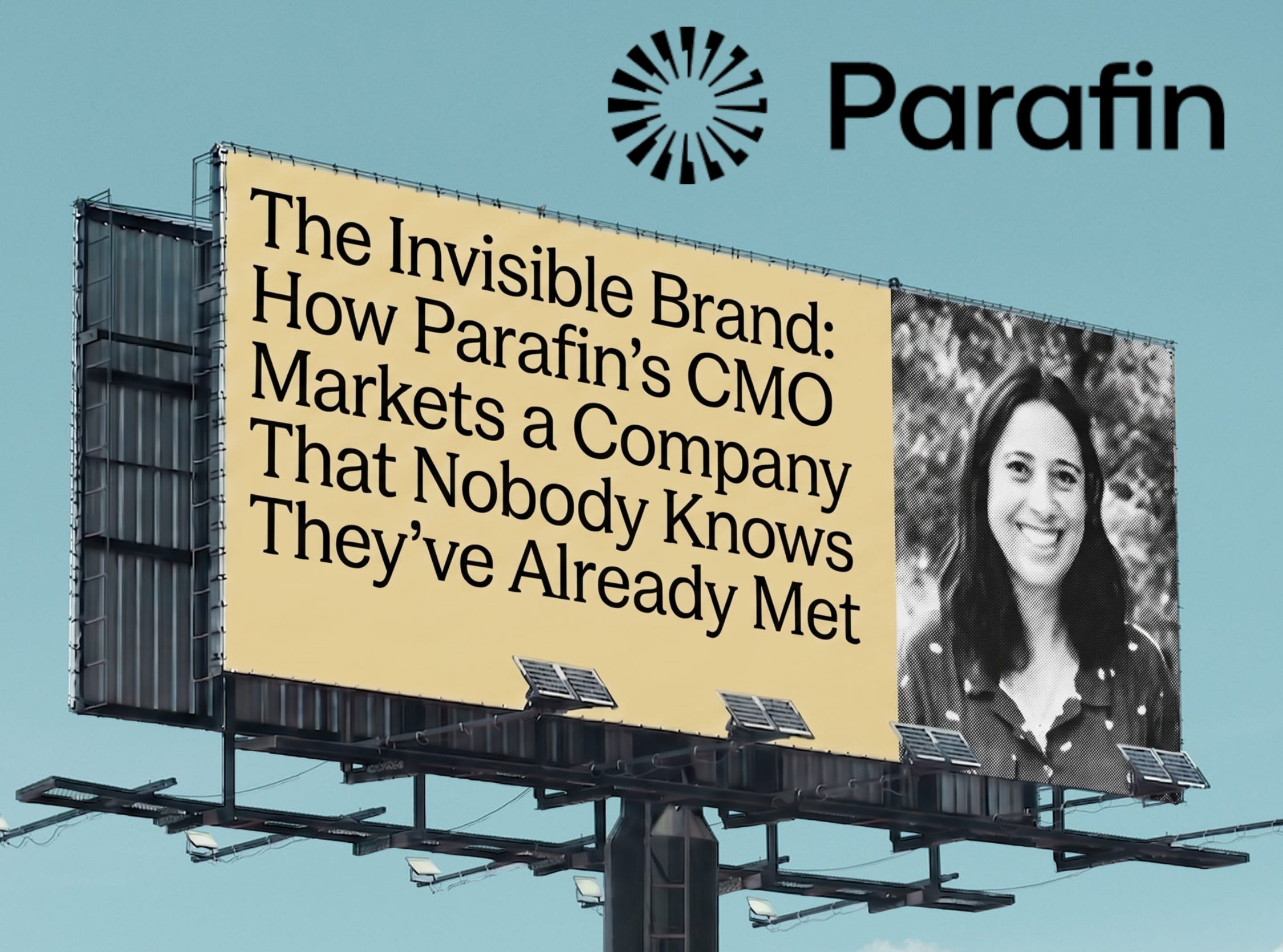
The Invisible Brand: How Parafin’s CMO Markets a Company That Nobody Knows They’ve Already Met


When Your Best Customer Has Never Heard of You
Andrea Leewong has a marketing problem most CMOs never face. The company she represents has likely already touched 20% of U.S. small businesses with employees via platform partnerships. Its products sit inside platforms that millions of restaurant owners, fitness studio operators, and e-commerce sellers open every single day. But almost none of those people know Parafin’s name.
“It’s called DoorDash Capital. It’s called Mindbody Capital,” Andrea says. “Here and there, there’s a little bit of information about Parafin.”
For most of her career, Andrea worked in businesses where the entire model depended on being seen. At NerdWallet, organic search was the focus every function in the company worked toward. At Opendoor, personalized direct mail placed a specific dollar offer in someone's hands. Visibility was the mechanism. Now she runs marketing for a company that operates, by design, in the background. She’s navigating a fundamental tension point: how do you build brand equity for something that is structurally invisible, and should you even try?
Her answer is yes. But the path to get there is unlike anything in her prior playbook.
Meet Andrea and the Company She’s Building For
Andrea joined Parafin after years working across some of the more data-intensive marketing environments in fintech and real estate. NerdWallet taught her what it looks like when an entire company locks onto a single growth objective. “Everyone across every function was driving to that goal of organic search,” she recalls. “I haven’t seen that level of alignment and ownership across a company before.” Opendoor taught her the power of a personalized, well-timed offer delivered at the exact moment someone is ready to act.
Both experiences shaped how she thinks about the small business financing problem Parafin is trying to solve. Small businesses, she explains, have historically been misclassified. They are too small to qualify for enterprise lending, yet too complex to be treated like consumer borrowers. Banks have long defaulted to evaluating them through the lens of the owner’s personal credit score, personal guarantees, and personal financial exposure.
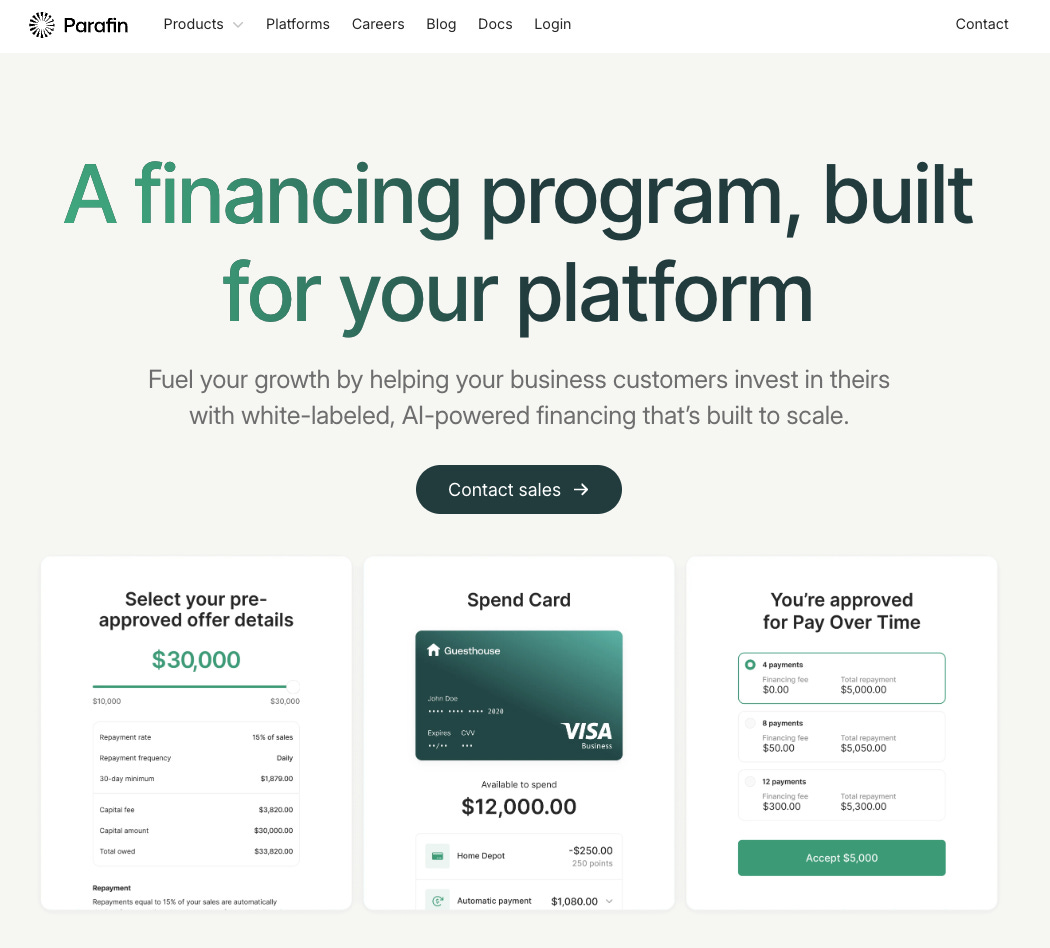
Parafin works differently. The company embeds its lending infrastructure directly inside the software platforms that small businesses already use to manage their operations. A restaurant running on DoorDash generates real revenue data inside that platform. Parafin builds data-sharing agreements with partners like DoorDash, Mindbody, and Jobber to run machine learning models against that anonymized transaction data. The underwriting is based on how the business actually performs, not on who owns it.
“It doesn’t matter who the owner is, actually,” Andrea says. “We think that creates a more inclusive approach to financial services.”
The company handles underwriting, servicing, customer support, and the full lending lifecycle. The platform partner handles the relationship with the merchant. Parafin handles everything behind it.
The Engine: Two Acquisition Problems Running in Parallel
What makes Andrea’s job structurally unusual is that Parafin has two entirely separate acquisition challenges happening simultaneously, and progress on one does not automatically produce progress on the other.
The first challenge is enterprise B2B acquisition. Before a single small business can access a Parafin product, the company must first land a partnership with a major software platform. These integrations are deep, complex, and slow to negotiate. “You cannot easily launch a deep integration with Amazon,” Andrea notes. That difficulty is also the moat. Once a partnership is operational, it is not easy for a competitor to replicate.
The second acquisition challenge is what happens after the integration goes live. Getting a small business owner to notice, trust, and act on a financial offer inside a platform they use for something else entirely is its own problem. The best version of that moment, in Andrea’s view, is one where the offer is contextual and appears at the exact point of need.
She points to Parafin’s partnership with Gusto, the payroll platform, as a concrete example. Small businesses can access a line of credit right at the moment they need it most to ensure their teams get paid on time. “A lot of times it’s really about cash flow,” Andrea says. “It’s not that they don’t have revenues coming in. It’s a matter of customers maybe not paying them for a few weeks.”
The offer often reaches businesses that were not actively looking for financing but are genuinely well-positioned to use it. “We find that we are able to attract better businesses because of that,” she says.
Outside of those embedded moments, Parafin uses email triggers and platform notifications to drive awareness. Andrea is also exploring direct mail, drawing on her Opendoor experience, where personalized offers delivered to physical addresses converted well. The translation is not one-to-one. “Who is the recipient of the mailer? Is it actually someone who can make a decision or is it someone who’s just working at the business?” She is testing, not declaring victory.
The Craft: Brand as a Competitive Moat
For most of Parafin’s history, the question of brand was largely set aside. The company was infrastructure. It was white-labeled. It did not need a name in the market. Andrea’s arrival signals a shift in that thinking, and she credits her CEO and founder, Sahill Poddar, with pushing it forward. Sahill shared an article with her about the luxury watch industry, in which brands that competed on precision and technical specs eventually found those differentiators commoditized. The ones that endured did so on the strength of something harder to copy.
“We can’t just, and we don’t want to, compete on features,” Andrea says. “I don’t think we can necessarily claim to be the only ones who can ever do it.”
The brand she is building has two audiences. Platform partners need to see Parafin as a design partner, a company that goes above and beyond on integration, ease, and long-term commitment. Small businesses, once they encounter the product, need to feel that the company behind it cares about their actual situation.
When asked which brands she admires, Andrea does not cite a financial services company. She mentions Trader Joe’s. “They are so consistent. They have a whimsical nature to them. I’m literally shopping for groceries, and it shouldn’t be that exciting, but it’s so fun.” She also mentions Costco: unwavering in its identity, clear about what it stands for, committed to the members who keep coming back. “You know who they are and you know what they care about.”
In the B2B space, she points to Ramp. She admires how Ramp uses individual voices within the company, its founder, its chief economist, its team members, to carry ideas that resonate more than a brand speaking to itself. She also notes how Ramp has found a tone, light enough to be entertaining, serious enough to be trusted. “They’ve toed the line with some lightheartedness, but people take them seriously still.”
For Parafin, she does not think humor is the right register. The subject matter is financial pressure and the audience is people who work hard and have a lot on the line. The brand, when it fully emerges, will need to reflect that seriousness while still feeling like a partner rather than a vendor.
The AI Question: Treating the Tool Like a Junior Analyst
Andrea’s most direct advice to other marketers has nothing to do with channels or campaigns. It is about how to use AI to answer the questions marketers always have but rarely get answered.
“Marketers often do not have enough access to data scientists,” she says. “I think that is a significant, significant unlock.”
Parafin has connected its enterprise AI tool directly to its backend database, giving Andrea’s team the ability to ask questions in plain language against a dataset covering millions of small businesses. She is careful to frame what that actually looks like in practice. “It is a back-and-forth dialogue and a conversation with AI. You need to not be lazy and take V1. You need to probably be getting to V10 or V15 or V20.”
The mental model she uses is direct: treat the AI like a talented junior analyst who is excellent at certain things but does not yet know what matters. The marketer still supplies the judgment, the taste, the knowledge of what an interesting insight would actually look like. The tool helps surface patterns and validate directions faster than a SQL query submitted to an overstretched data team.
The Open Question Ahead
The most candid moment in the conversation comes when Andrea describes the challenge that does not yet have a clean answer. Parafin has strong distribution through its platform partners. It has proprietary data that most lenders could not access. It has a defensible model. What it does not yet have is a name that small businesses recognize or seek out on their own.
Some of them find Parafin anyway. “People are still going directly to our website and actually filling out a form,” she says. That direct pull is a signal, a small one, but a real one, that the brand has value even before it is fully built.
Her task now is to close the gap between the infrastructure Parafin has already built and the identity it has not yet claimed. In a market where platform partnerships take years to develop and underwriting models run on data that competitors cannot easily replicate, brand may be the last remaining differentiator that is both meaningful and genuinely hard to copy.
“The sum total of experiences that a person or a company has with you,” she says, “is probably more important because of how easy it is to spin things up these days.”
Andrea is building for a future where platform decision-makers and small business owners know exactly who Parafin is and choose it because of that knowledge. The infrastructure is already there. The name is still catching up.
More from Uncovered Media


 | A guest post by
|
 | A guest post by
|