




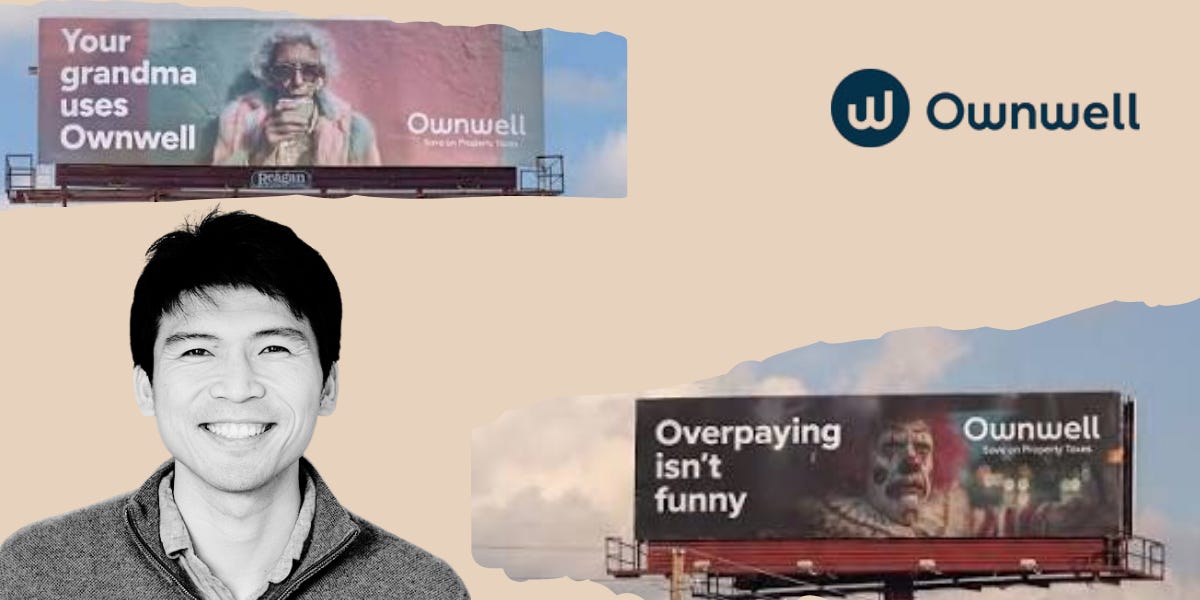
In 2025, Americans were charged nearly $397 billion in property taxes on single-family homes. The average annual bill reached $4,427, and that was up 3% from 2024. Property taxes remain deeply unpopular with homeowners, yet, despite the unpopularity, fewer than 5% of homeowners dispute the assessed value used to calculate their annual bill.
On Paper, Ownwell’s value proposition looks almost frictionless. The company challenges the assessment on a homeowner’s behalf and gets paid only if it saves them money.
When Chang Fu joined Ownwell as the vice president of marketing and growth, he had actually challenged and won his own assessment in Seattle. This made the case for Ownwell’s existence seem obvious, challenge an inflated assessment, lower the bill.
Then he decided to navigate the appeals process on his own in a different market — Austin, Texas. This time, he knew more and prepared himself with data and evidence. As he waited to present his case at a formal hearing, he was unexpectedly nervous. The experience exposed something his Seattle appeal hadn’t; the cost of challenging the assessment wasn’t limited to money. There was also the time, expertise and anxiety required to do it.
“I thought it was all about savings. I was wrong.”
The Burden Has a Name
What Chang experienced was given a name by public policy researchers who spent years studying what happens when people are forced to navigate complicated government systems. It’s called administrative burden.
The researchers behind the framework break administrative burden into three types: learning costs, compliance costs and psychological costs. Property tax appeals manage to hit all three.
First, a homeowner has to determine whether an assessment is actually incorrect, understand what evidence matters for their particular jurisdiction, and meet local filing deadlines. Then comes the collection of evidence. This might entail comparable sales, property records, photographs, and any other necessary information. Finally, depending on the jurisdiction and outcome, there may be negotiations or a formal hearing.
Those rules vary from one place to another, changing the way Ownwell has to think about both its product and its messaging. The obvious value proposition is a lower property tax bill, but the company also absorbs the learning, work and anxiety required to pursue one.
This is the part of Ownwell’s value Chang didn’t fully appreciate until he was sitting in his own hearing with all of his prepared evidence.
When an Offer Sounds Too Good
Ownwell’s economic proposition sounds unusually favorable for the homeowner. Let the company evaluate the property, handle the appeal, and pay only if Ownwell saves them money.
Consumers are trained to be wary of a too-good-to-be-true deal.
The offer doesn’t immediately inspire confidence. It creates questions. What information does the company need? What happens to that information? What am I agreeing to? How realistic are the savings? Why would a company do all of this work without charging upfront?
The strength of the offer ultimately became positioning friction for Chang and his team. They responded by letting the economics speak for themselves with specifics. Instead of throwing out a theoretical best-case savings scenario, they show the current assessment, applicable tax rate, the property value based on supported evidence, and the potential savings.
Additionally, if Ownwell takes a look at all the evidence and it doesn’t support a reduction, they tell the client to wait. A company can tell people that its incentives are aligned with theirs, but recommending against filing an appeal gives them proof to trust.
National Market, Administered Locally
Every homeowner in the country pays property taxes but every state and county has different regulations and rates. The economics of homeownership can look completely different in Austin, Atlanta, and Long Island.
Early in Ownwell’s expansion, the company occasionally entered markets without fully appreciating those differences. From headquarters, the marketing made sense. However, on the ground, Ownwell could look like a tech company arriving with software and data to solve a problem rooted in local government.
That can be a dangerous perception when the service depends on understanding rules homeowners find difficult to navigate. So team members began traveling to cities to speak with customers. They looked at their own billboards and marketing materials, and scrutinized which messages felt off-brand in the local market.
The company also built relationships with local organizations and recognizable figures including the San Antonio Spurs, the New York Islanders, former Texas football coach Mack Brown and Austin youth soccer organization FC Westlake. These partnerships were confirmation that Ownwell understands the markets where it operates. The partnerships help establish the local credibility Ownwell needs when asking homeowners to trust it to navigate government systems on their behalf.
“People really care that you understand their market, their situation, their specific home.”
Technology companies are usually rewarded for doing the opposite. They automate work that once required people, and reproduce successful campaigns across markets, removing local variation wherever it creates unnecessary cost.
Chang and his team understand that the homeowner’s assessment belongs to a particular house in a particular county operating under a particular set of rules. The closer Ownwell gets to reducing a homeowner’s assessment, the more those details matter. But understanding the system is only useful if Ownwell can convince homeowners to engage with it in the first place.
When Your Competitor Is Doing Nothing
For all of the complexity Ownwell removes from the tax appeal process, Chang’s biggest marketing challenge is remarkably simple. He’s competing with doing nothing.
Property taxes are unusual in that homeowners can be deeply unhappy with the assessment and still accept it. That creates an odd marketing problem for Ownwell. The company doesn’t necessarily have to persuade homeowners that property taxes are too high. Many already believer they are. It has to persuade them that the number can be challenged and outsourcing the process is worth doing.
It’s confession time. I had a chance to fight my property tax assessment, and did nothing. I’ve been following the Ownwell story since 2024. I’m intimately familiar with the value proposition and ease of engagement, and still didn’t take action.
It gets worse. I live in Denver, Colorado, and, on cue, Ownwell sent a mailer ahead of my appeal. A week later, my assessment arrived higher than ever. I remember thinking how genius the timing of the mailer was and deciding this was the year I was going to appeal. For seven days, the task was on my to-do list, then eventually fell off entirely. By the time I thought about it again, it was too late. The window had passed and I once again accepted my 140% increase.
After listening to Chang describe Ownwell’s greatest marketing challenges, I realized that he was speaking to my behavior. Every hesitation I had, Chang named. I knew there was something I could do about it. I even knew the company offering to do most of the work. And still, inertia won.
That’s the clearest example of the challenge Ownwell is aiming to solve. Sometimes the hardest part of changing behavior isn’t giving people a better option, it’s getting them to act.
More from Uncovered Media


