



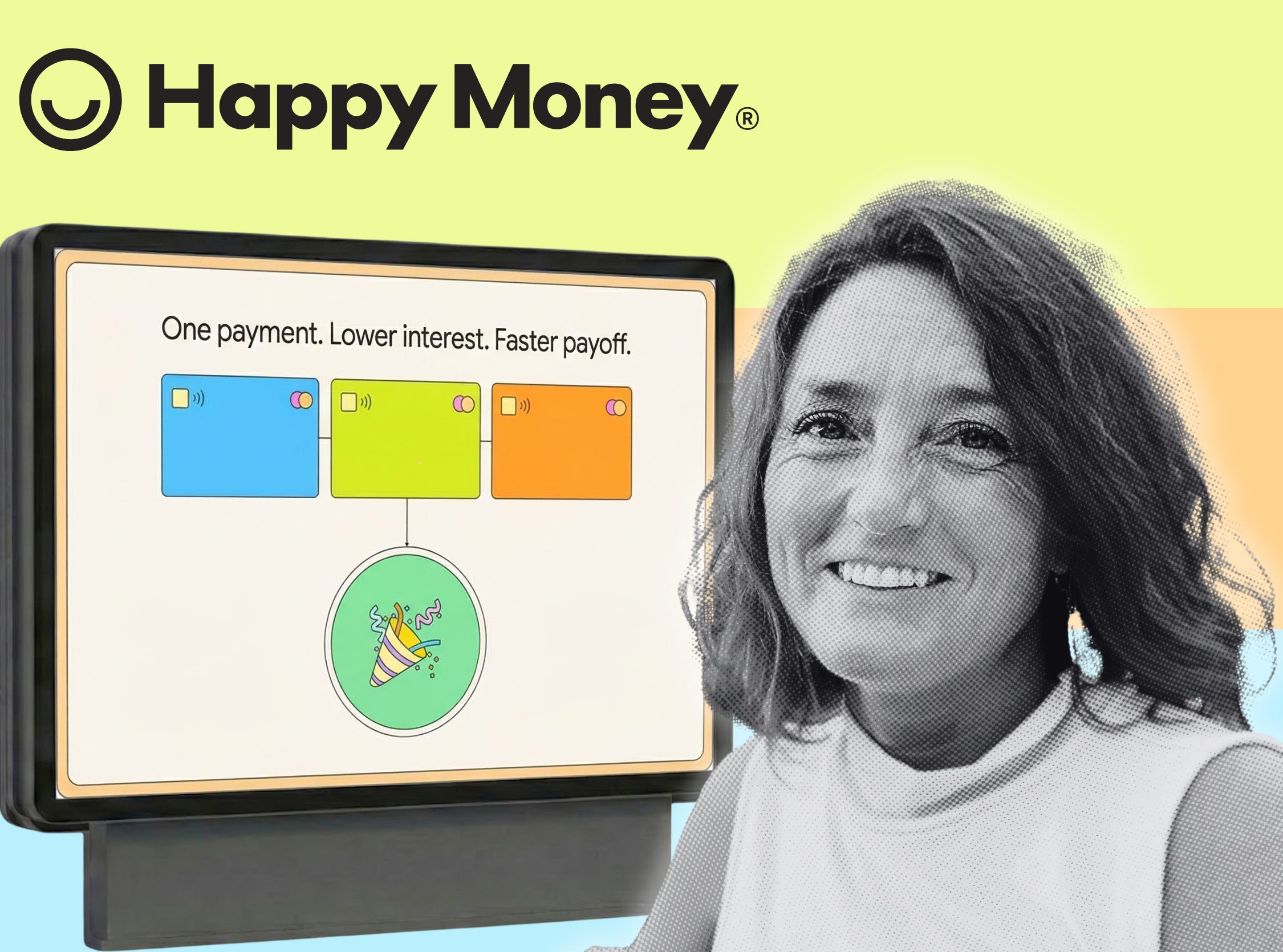
Isla Dickerson has a framework she uses before she touches a campaign brief. She does not start with key performance indicators. She does not open a channel dashboard. She starts with a question most marketing teams have set aside: what does this person actually feel right now?
As Head of Marketing at Happy Money, a consumer finance company that has helped more than 350,000 customers achieve their goals with a personal loan that provides a path out of credit card debt, Isla centers her operating philosophy around the gap between behavioral data and experiential truth. In her view, that gap is where most modern marketing falls short — and where the next generation of great brands will be built.
Meet Isla
Ask Isla about her ideal life and she does not hesitate. In the summer, she would run a bed and breakfast on an island off the coast of Maine, cooking lobster stew and strawberry rhubarb pie for interesting strangers, listening to their stories, and photographing the food for a cookbook she would write during winters in Hilo, on the quiet side of Hawaii’s Big Island. Every detail has a purpose. Every element earns its place. That instinct, to find what is true and what resonates, runs through everything she does at work.
From Community Banking to Fintech: What the Jump Actually Taught Her
Isla’s career began at a large independent credit card issuer, where volume was the currency and acquisition was the objective. After years at that scale, she founded an award-winning marketing and communications agency that never advertised, then returned home where she spent eight years leading marketing, community relations, and public relations at Bangor Savings Bank. Out of the blue, a former colleague called to say he had co-founded a startup and needed help. She left the structure of community banking for the disorientation of fintech.
What she found on the other side reframed how she thinks about the entire discipline. In a startup, product and marketing are not separate functions. They are often the same person making the same decisions.
“You are building a product while you are designing a marketing campaign and oftentimes you are doing that before the product is even fully built.”
She had to create marketing for an unfinished product while simultaneously marketing the organization, its people, structure, and potential, to multiple audiences. No historical data. No established playbooks. The friction was the education.
That experience sharpened a belief she now holds firmly: the best marketing thinking happens before the metrics arrive.
“Performance Ready” vs. Performance Marketing: A Framework for Building Backwards
Isla draws a distinction that sounds subtle but carries real consequences for how a team operates. She calls it the difference between performance marketing and being performance ready.
Performance marketing, as it has been practiced for the past two decades, starts from the back end. You define your target cost per acquisition. You set your click rate benchmarks. You design creative to pass an A/B test window. You optimize. The numbers tighten. And then, slowly, something else happens: the campaign converts in the moment but does not stick. The customer clicks and then leaves. The brand registers and then disappears.
“You’re optimizing yourself into this corner where everything converts in the moment, but it doesn’t resonate and it doesn’t stick.”
Performance ready is the opposing motion. You start with a human truth. What does this person fear? What are they hoping for? What would make them feel seen rather than targeted? You build from that place. You honor that truth in the creative before you touch the measurement framework.
“It’s not anti-data. It’s not dismissing the need for measurement. This is actually the more data-driven, rigorous approach.” Being performance ready multiplies what you measure and how you build. It expands the system beyond conversion to include sentiment shift, brand recall, referral, and long-term value, because you are no longer optimizing for the moment. You are designing for what makes performance sustainable. That requires deeper analysis, stronger synthesis, and tighter integration between data and human understanding. You are not just measuring what happens. You are designing for why it happens.
The campaign still gets measured. It just gets built differently.
Emotional Precision: The Operational Problem She Is Solving Right Now
Isla uses the phrase “emotional precision” to describe where she believes marketing is heading and where Happy Money is actively working towards.
She is not talking about putting a first name in a subject line. That, she says, is a playbook that was already aging before email existed. “We transferred the way that we wrote direct mail pieces into the email journey. Same content, different medium, no evolution.” What she is describing is harder to engineer: understanding not just what a customer did on your website, but why they did it, and what emotional state they were in when they arrived.
For Happy Money, this is not theoretical. Two visitors can land on the same debt consolidation page through the same search. One is on their lunch break, casually comparing rates. The other is at 2 a.m., having avoided their credit card statement for three weeks and living with constant financial anxiety. The action that got them to the site is identical. What they need from you at that moment is not.
One needs a nudge. The other needs reassurance. A single campaign version serves neither of them well.
Operationalizing this requires segmentation not just by behavior or demographic profile, but also by stage of readiness. Isla frames it as a binary: is this person in problem-awareness mode, or are they in immediate-action mode? That distinction shapes message, tone, creative direction, and offer structure.
The data needed to make these distinctions exists. The constraint has been speed: the inability to extract and act on contextual signals fast enough for them to be meaningful. That is the opening for AI.
Machines for Intelligence, Not Wisdom
AI handles the mechanical layer: A/B testing, bid optimization, content variations, reporting. It gets the middle steps done faster. What it cannot do is understand why a customer who just consolidated $30,000 in credit card debt might feel simultaneously relieved and ashamed. “It can’t feel the difference between a headline that’s clever and one that’s really true.”
“It’s machines for intelligence. It’s not machines for wisdom.”
The practical implication for her team is that AI accelerates the pipeline to insight. It surfaces patterns in data that used to take weeks to extract and makes them available in hours. That speed frees up human judgment to do the harder work: identifying the emotional truth, building the creative that honors it, and making the call on where to press and where to pull back. The skill that appreciates in value is not execution speed. It is human interpretation.
On agentic commerce, where AI agents locate and evaluate financial products on a customer’s behalf, she is measured rather than alarmed. “We are already heading down that path,” she says, drawing a direct parallel to the early days of Google search and the emergence of SEO. The search tools change. The underlying imperative: to be findable, credible, and emotionally resonant when the moment arrives, stays constant.
Credit Risk, Product, and Marketing
At Happy Money, Isla does not run marketing as a standalone function. Her closest operational partners are the credit risk team and the product team. She describes the three as pillars: none of them move without at least informing the others, and most significant decisions surface through all three before any action is taken.
The credit risk partnership is particularly concrete. Happy Money receives leads through affiliates, email, prior customer lists, and pre-screened direct mail channels. Every campaign Isla runs is shaped in dialogue with the credit risk team’s modeling. They inform her segmentation. They help build out personas. They review creative, not for compliance alone, but to ensure that the people being targeted with a given message are the people the model has identified as the right audience for that offer.
“Designing creative that blends and serves the segmentation that credit risk models out is an art.”
The result is a pre-screened direct mail process that operates as a precision instrument: response rates, approval rates, and risk-reward weighed together. Marketing and credit risk are not running separate plays. They are co-designing the same one.
Loyalty as Forgiveness: The Long Arc of Retention
The definition of loyalty Isla operates from now is less about repeat purchase and more about forgiveness.
“Repeat purchases are the baseline. Loyalty is resilient trust—the kind that holds when something goes wrong and the relationship endures. And it’s that trust, not behavior, that ultimately defines customer long-term value. If we’re not measuring it, we’re missing the signal that matters most.”
Her example is L.L. Bean, a brand she grew up with in Maine. When the company changed its longstanding return policy, one she had relied on personally, they explained the decision in a way that made sense to her. The relationship held. She still buys from them. She still recommends them. The brand had built enough trust that a broken promise did not break the relationship.

That is the standard she is building toward at Happy Money. Campaigns that convert are an imperative. Relationships that survive a mistake are the goal.
Looking Ahead: The Marketer as Psychologist
The marketing team of the future, as Isla envisions it, still operates as a performance engine, but one increasingly powered by AI and machine learning. Automation takes on execution and optimization, making the system faster, more precise, and more efficient.
Alongside it, a human data lab emerges. Fewer specialists focused on channel mechanics. More psychologists, storytellers, and community builders. More people with experience beyond marketing: those who have run businesses, worked in customer service, or developed a deeper understanding of human behavior, capable of directing machine output with judgment and applied wisdom.
“You can never outsource humans. We’re selling things to humans. We need human wisdom to do that effectively.”
The technical layer scales through automation. The human insight layer directs it and becomes the competitive advantage. The role of the CMO expands accordingly: still building and managing a demand generation engine, and now requiring an honest read of what customers feel and experience with the ability to translate that truth into inputs that guide the system, so what gets optimized is not just efficient, but meaningful.
Start with insight. Build for stickiness.
More from Uncovered Media


