




The Brand Beneath the Platform
Jess Wen does not separate brand from growth. After eight years and more than 150 venture-backed companies, she has stopped treating them as competing priorities.
“Brand is what people say about you when you’re not in the room,” she says. “It’s the sum total of all touch points.”
That definition sounds simple. The execution is not. For Jess, brand is not a logo refresh or a tagline. It is every product decision, every certification pursued, every member story told, and every moment a company chooses to act in accordance with what it says it believes. When a company does that consistently, over time, something measurable happens. Retention improves. Referrals increase. Word of mouth compounds.
That is the financial case for brand. And it is the operating thesis behind her work at SoLo Funds.
Meet Jess
Ask Jess about her ideal environment and she does not hesitate. A cozy room, a stack of books, a cup of hot tea, and what she calls her “fat lazy dog.” She is currently reading “The Anxious Generation” by Jonathan Haidt. She gamifies her personal life the way she structures her professional one: with deliberate quests. Last year, during a sabbatical in San Francisco, she set a goal of 100 new experiences in the city. She completed it.
When she returned to full-time work, she found herself slipping back into routine. So she set a new side quest: introduce deliberate newness into daily life and keep wandering down the small alleyways of a city she already knows well. “Continue to discover, continue to be curious,” she says. For Jess, that restlessness is not a personality quirk. It is a professional discipline.
She also teaches. Jess runs a creative entrepreneurship course for undergraduate design students, a 15-week class that, in her words, makes her a better operator. “Teaching actually makes me better at my day job,” she says. “I see the parallel of people leaning into the skills they have and immediately wanting to flex that skill set.” Watching students default to building before defining the problem taught her something she now applies every day at work.
From Client Service to In-House: Two Very Different Maps
Jess spent the majority of her career on the client service side, working as an outside consultant across a broad range of venture-backed companies spanning sectors and stages. She describes the work as pattern recognition at scale. “I’ve probably seen a version of every possible problem within venture-backed companies,” she says.
That breadth trained her well. The transition to an in-house leadership role, however, required a different kind of map.
In client service, brand strategy begins with a bird’s-eye view of the customer journey. The team identifies key touch points across awareness, consideration, and engagement, scopes the work, executes with precision, and exits. The time horizon is short. The brief defines the boundaries.
In-house, the exercise runs in the other direction. Jess starts with the annual business roadmap and reverse engineers into the touch points worth prioritizing. “What is reasonable, given resources and dependencies? What are the A, B, C we should focus on to improve brand and experience for Q1?” The horizon is longer. The constraints are internal. And unlike a client engagement, there is no clean exit.
“I want to run with B and C initiatives, but the dependency results in a lot of reality checks and rescoping,” she says. “Picking the battles, when wearing an in-house leadership hat, is about having my immediate function’s priorities and goals but also handling curveballs with grace and a collaborative spirit.”
The Patterns That Keep Repeating
After working with more than 150 venture-backed companies, Jess has catalogued a short list of brand failures that repeat across stages. Two stand out.
The first is what she calls the founder-as-brand trap. In the earliest days of a company, this is not a trap at all. It is necessary. Founders typically carry the charisma, the conviction, and the credibility. The brand and the person are inseparable by design. “Any entrepreneur who goes into a startup scenario usually has a certain charisma to really believe in what they’re building,” she says.
The problem arrives at the growth stage, when the company begins to scale and the founder cannot duplicate themselves five times over. If all of the brand equity has accumulated in a single person, the company has not built a brand. It has built a personal platform.
Jess uses an education metaphor to describe the transition. Early-stage companies are the grade schoolers. There are very few rules. The founder leads. But moving into the growth stage requires separating individual personal brand from company brand.
“The company brand needs to be strong enough and firm enough to stand on its own, without over-relying on the individual charisma.”
Her diagnostic question for founders who want to self-assess: when you walk into a conference and introduce yourself, do people think of your company name first, or do they think of you?
The second pattern is the “if we build it, they will come” assumption, most common among technical founders. Jess sees this clearly in the current AI funding environment, where some companies are getting away with skipping the story because capital is flowing fast. But she does not believe that lasts. “Those companies will not be the most stable ones going forward,” she says. The mirror image of that failure is the founder who sells aggressively before the product exists and then scrambles to build it after. Both profiles skip the same foundational question: what problem are we solving, and who actually cares?
She points to consumer brand companies as a model for tech founders to study. Omsom, a direct-to-consumer sauce brand co-founded by two Asian American sisters, earns her admiration not because of its size but because of its clarity. The company solved a specific problem: busy professionals who want to cook flavorful, internationally inspired meals without stocking dozens of bottles and knowing what to do with them. “They found their story early on,” she says. “They are solving a very clear problem that people care about.”

SoLo Funds: Humanity Inside a Financial Product
Jess first encountered SoLo Funds in 2020 as an outside consultant, brought in to lay the initial brand foundation for a peer-to-peer lending and borrowing platform still finding its language. She joined full time as Vice President of Brand and Growth in December 2025.
SoLo Funds operates as a community banking platform. Roughly 50 percent of American households live paycheck to paycheck, a figure the company tracks each year through its Cash Poor Report, produced in partnership with academic research institutions. When an unexpected expense hits, which it does, frequently, the traditional options are either a big bank or a predatory lender. SoLo offers a third path. The platform connects members who want to lend with members who need to borrow. Nearly three million members strong, the platform recorded close to 600,000 individual peer-to-peer transactions in 2025 alone. SoLo also holds the distinction of being the first and only B Corp certified lending company in the United States.

The brand work Jess began in 2020 had a clear brief: bring humanity into fintech. “Every messaging, visual, and brand touch point needed to really honor that,” she says. The founders, both Black, built the company from direct experience. They had been the person who needed to call a cousin or an aunt for help getting by. That sincerity, in Jess’s view, is not a marketing angle. It is the actual brand. “Over time, it’s not just a founder story,” she says. “It’s about actual member stories, people who are benefiting from our platform.”
The B Corp certification is a concrete example of how that belief system translates into a business decision. Going through the certification process requires significant resources and a rigorous accounting of social impact practices. The company chose to do it anyway. “The willingness to commit the resource to go through it backs the belief system,” Jess says. That commitment is brand. The certification is the proof.
Why Brand Matters More Now Than It Did Before
Jess makes a specific argument for why brand has become more important in the current environment, not less. Product parity is accelerating. With AI tools now available to most teams, shipping a clean, functional product is becoming closer to a baseline expectation.
“Consumer expects the product to work. Beyond that, whether or not it can speak to people, relate to people, connect to people, all of that is the importance of brand.”
She frames it bluntly. “Everything looks the same.” Consumers are fatigued. Attention spans have shortened. The volume of content, advertising, and product noise flooding any given channel has never been higher. In that environment, the companies that earn trust are the ones that stand for something clearly and demonstrate it repeatedly. Not through campaign flags. Through consistent behavior over time.
The analogy she draws is a useful one. Nike does not put a consumer’s name on an ad to earn business. Nike earns business by consistently aligning with aspiration through the athletes it chooses, the stories it tells, and the standard it sets for what the brand represents. That distinction, between brand audience and acquisition audience, matters.
“Brand should always feel a little more aspirational versus the acquisition audience who will actually use the product.”
AI, Personalization, and the Limits of Automation
SoLo Funds recently built and launched SoLo IQ, a proprietary AI-powered personal finance tool available to members within the platform. The motivation was observational. The team noticed members uploading personal bank statements into open-source AI tools to get budgeting advice. Recognizing a significant data risk, Solo developed a GLBA-compliant, secure, and encrypted alternative inside its own ecosystem.
The response was immediate and overwhelming. Between September 2024 and now, the platform recorded 74,428 unique IQ users against 68,290 unique borrowers—an adoption rate of 109%. This figure exceeds 100% because the tool’s value extends beyond active borrowers to members simply browsing the app or exploring features. It isn’t just a novelty, either: SoLo IQ maintains 94.65% uptime, averaging 23 conversations per hour, with 93.34% of those interactions delivering measurable value to the user. The product did not begin as a growth initiative; it began as a response to a real and specific human need.
The retention data tells an equally compelling story—and reinforces that brand is built across every touchpoint a member encounters, not just marketing campaigns. SoLo IQ users retained at 69.4%, compared to 60.6% for non-users, a lift of 8.8 percentage points. The more striking figure is on the lender side: IQ-enabled lenders retained at a rate 13.5 points higher than their non-IQ counterparts. Because lenders represent the supply side of the marketplace, that number carries outsized weight.
On the question of AI within her own team, Jess is measured. She references a Harvard Business Review article that found people are working more, not less, after introducing AI into their workflows. She sees that pattern in her own department. Every Thursday, her team holds a learning session dedicated entirely to sharing new AI workflows with each other, a structured attempt to raise collective literacy rather than assume everyone will figure it out independently.
Her framework for how AI changes the role of the marketer: AI is excellent at repeatable tasks and detailed research. Humans remain responsible for weaving those outputs into a coherent point of view. “I need the human intelligence to tell me the so what,” she says. Her goal is to move team members from straight-line execution toward a higher altitude, where the job is connecting dots and understanding the strategic reasoning behind the work.
"I need to elevate my team from a straight-line execution perspective to an airplane view. A higher altitude where you see a wider picture, connect the dots, and understand the strategic thinking behind why we are running all of these tasks in the first place."
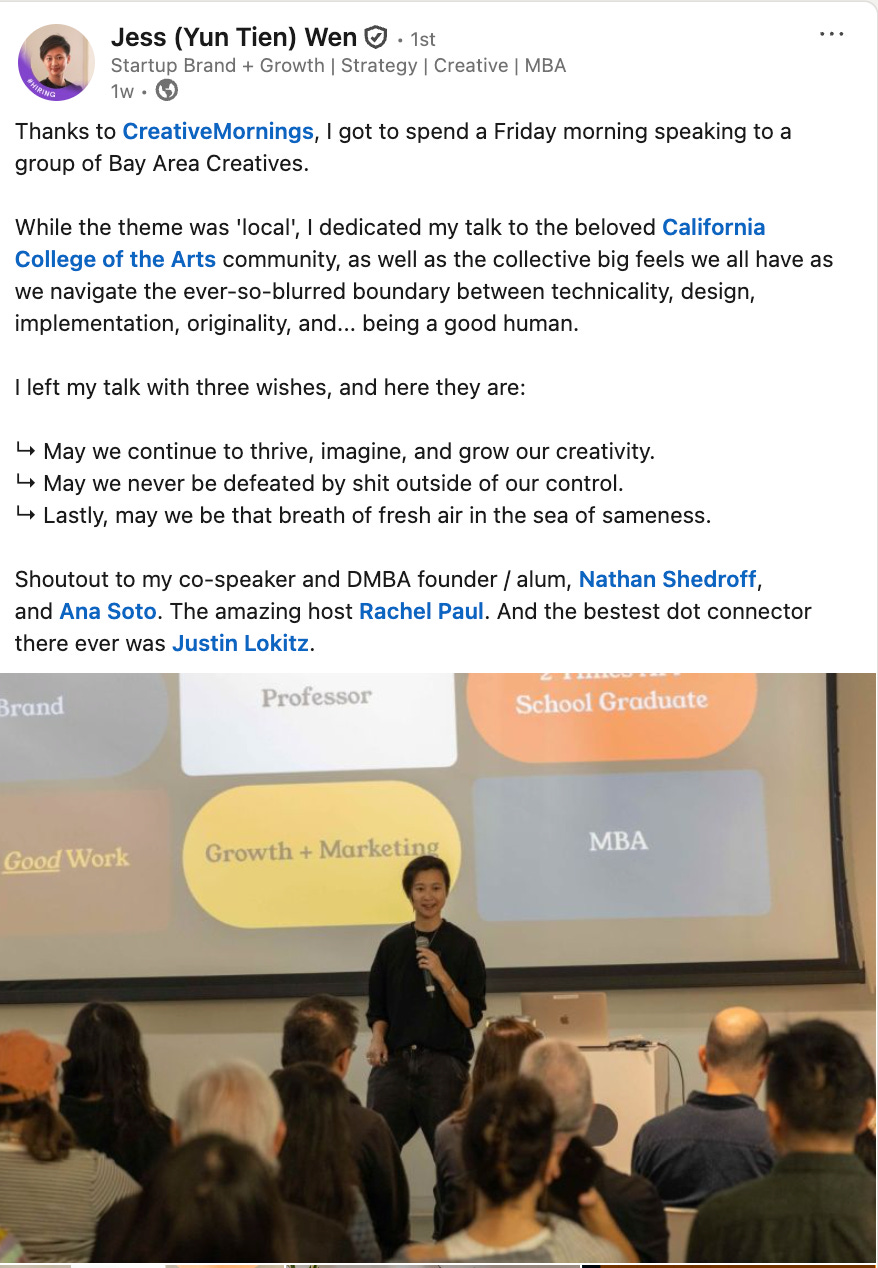
She gave a talk to roughly 200 creatives in San Francisco two weeks before our conversation. Her call to action: continue to imagine, continue to grow in creativity, and continue to elevate your taste. Not just from good AI output to acceptable AI output, but from acceptable to genuinely great. “It’s not prompt it and forget it,” she says. “How do we continue pushing apart and moving forward?”
Looking Ahead
Jess is thinking about what comes after SoLo IQ. The next chapter, she describes as a “bit of a spoiler,” involves using AI analytics to tell a larger data story about everyday American spending habits and financial behavior. SoLo sits on a rich and growing proprietary data set from millions of members across diverse economic circumstances. The team is working toward surfacing that data in ways that reveal something true and specific about how ordinary households manage money, not to sell a product but to anchor a public narrative.
For a brand built on the premise that the financial system has underserved a significant portion of the population, that kind of data storytelling is not adjacent to the mission. It is the mission made visible.
“I think there is a lot of very rich story there. AI for real human needs that realistically benefit not just the top one percent, but a much wider population.”
As AI tools spread further into daily consumer behavior, Jess believes the most durable brands will be the ones doing exactly what SoLo has always done: starting with what is real, telling it clearly, and earning trust one touch point at a time.
More from Uncovered Media


