





Money 20/20 is built for scale. An expo floor the size of a small town, back-to-back meetings, and booth conversations that all tend to blur together. So on Monday night in Las Vegas, CMO Uncovered went the other way. We booked a long table at BOA Steakhouse and sat down with 14 growth and marketing leaders.
The conversation bounced to various places but one conversation that was worth highlighting; when you can only make the next hire, which one do you make?
Should you hire a growth person? A general marketer? Or skip marketing for now and bring on a product person to drive a product-led growth (PLG) motion?
The question sounds tactical but it’s closer to strategy. Each answer implies a theory of how the company wins customers, and every early hire builds a team in its own image. Get it wrong and you spend a year optimizing a funnel that was never the constraint, or staffing a sales org for a product that should have been selling itself.

Let the product tell you who to hire
Mrinal Parekh, Clevertap marketing lead, had an answer that reframed the whole debate. Start with what the product can and cannot do on its own.
“If your product sells itself, your PLG motion is working, so maybe you need a growth person to handle it,” he said. “When your product isn’t selling itself is when you need a sales team. And when your sales team needs support and scale, that’s when you need a marketing team.”
Unpacked, it becomes a sequence where each hire is triggered by a bottleneck:
The product sells itself → hire growth. Users find it, activate and pay without talking to anyone. The job is to amplify a loop that already works - onboarding, activation, referrals, retention, pricing. A sales team here mostly adds cost to a motion that doesn’t need it.
The product can’t sell itself → hire sales. Long consideration cycles, multiple stakeholders, a price point that demands a conversation. Someone has to carry the deal across the line.
Sales can’t do it alone → hire marketing. Reps are prospecting cold, pipeline is thin, and buyers haven’t heard of you before the first call. Marketing’s job is to make every sales conversation easier - awareness, demand, and a brand that gets the meeting taken.
The notable move is where marketing lands. It isn’t the default first hire. It earns its seat when the motion in front of it starts to strain.
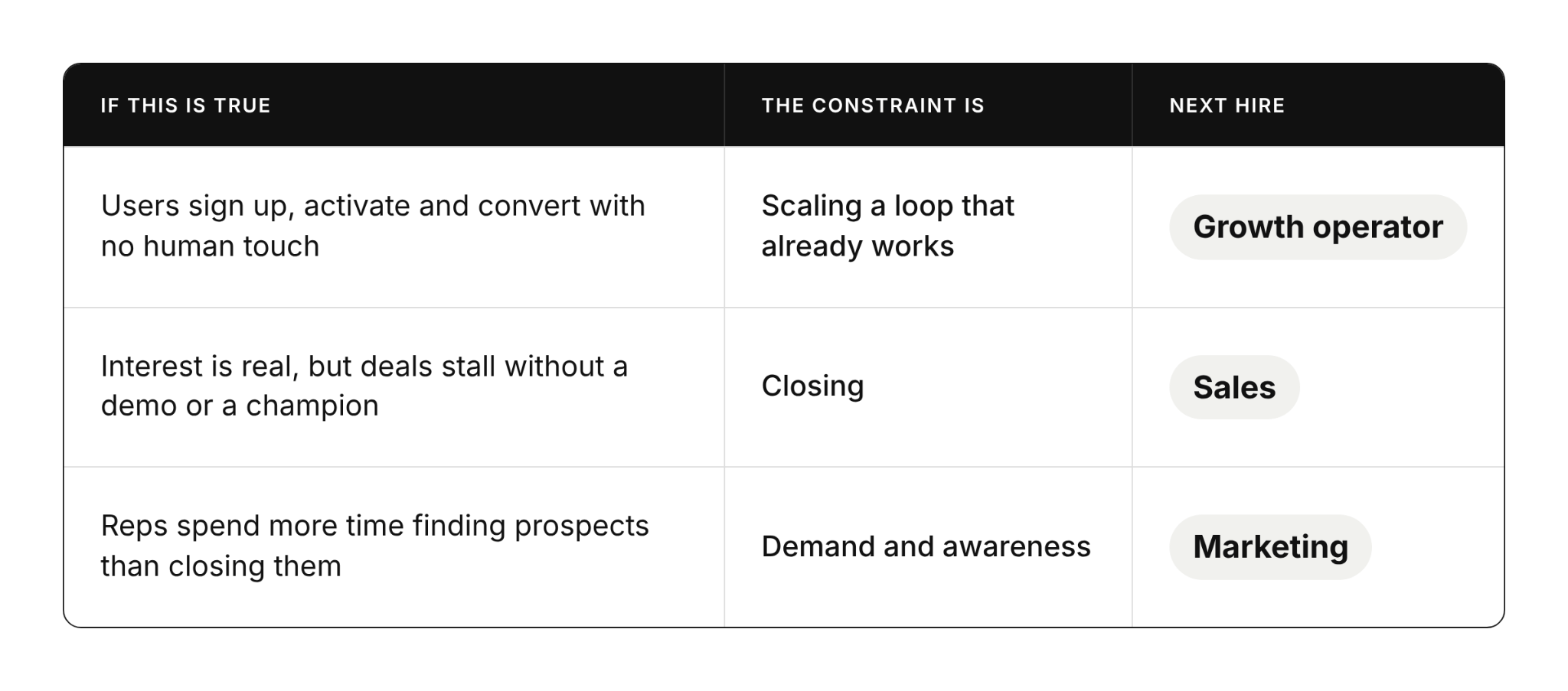
Two caveats are worth adding. First, a company can sit in different stages at once - self-serve for small teams, sales-led for enterprise. Second, the answer moves. The hire that was right at seed can be wrong at Series B, so the diagnosis is worth rerunning every planning cycle.
Mrinal added a point that applies once marketing is in the mix. Channels shouldn’t be ranked against each other in the abstract. “You can’t pit digital versus events,” he said. “They both have their own place.” A paid campaign captures demand that already exists.

Diagnose first, then hire
The question brought to the table is one nearly every growing company faces, usually with less time to think about it than it deserves. The answer that emerged over dinner is disciplined in its simplicity. Find where customers actually get stuck, and hire the person whose job is to unstick them.
This was one of several threads worth pulling from that night at BOA. In part two, we’ll pick up another - how marketing leaders are creating protocol on internal AI-written work as 2027 planning gets underway.
This season of CMO Uncovered is supported by CleverTap. CleverTap is the world’s leading engagement platform, helping brands build meaningful relationships through data-driven personalization. Powering over 2,000 customers globally, CleverTap’s AI-powered engine processes billions of data points daily to help marketers predict behavior and automate engagement at scale. From onboarding to advocacy, CleverTap provides the infrastructure needed to optimize every stage of the customer journey. For the CMOs building the next generation of iconic brands, CleverTap offers the precision and scale required to win in a crowded market. To learn more, visit clevertap.com.