



Ashley Kiolbasa didn’t hesitate when she told a crowd gathered on the rooftop terrace at 2 Penn that the rules of marketing have been rewritten.
“We as people have stopped browsing the internet completely. We’ve offloaded that chore to AI without even thinking about it, and that fundamentally changes the customer journey.”
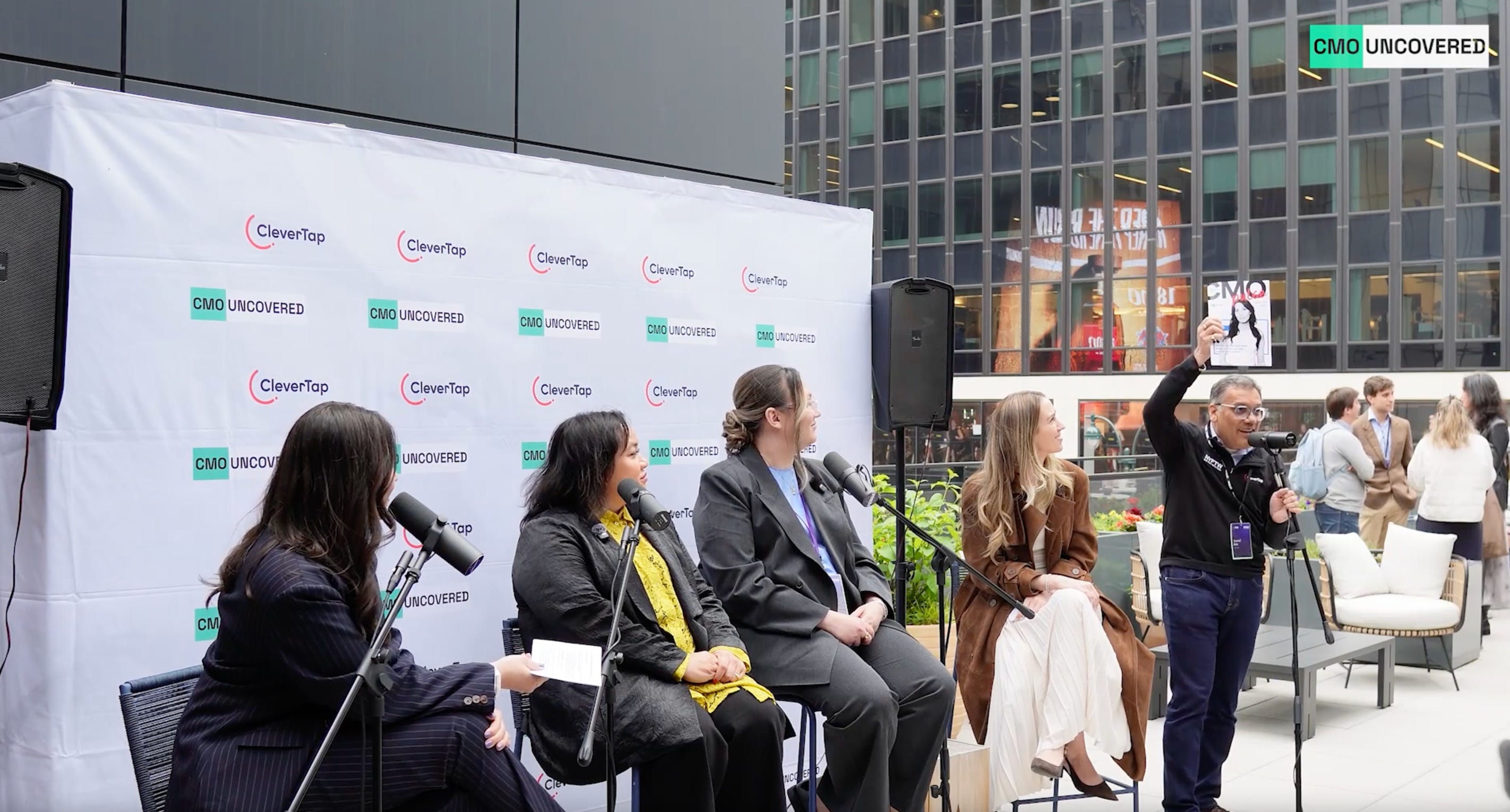
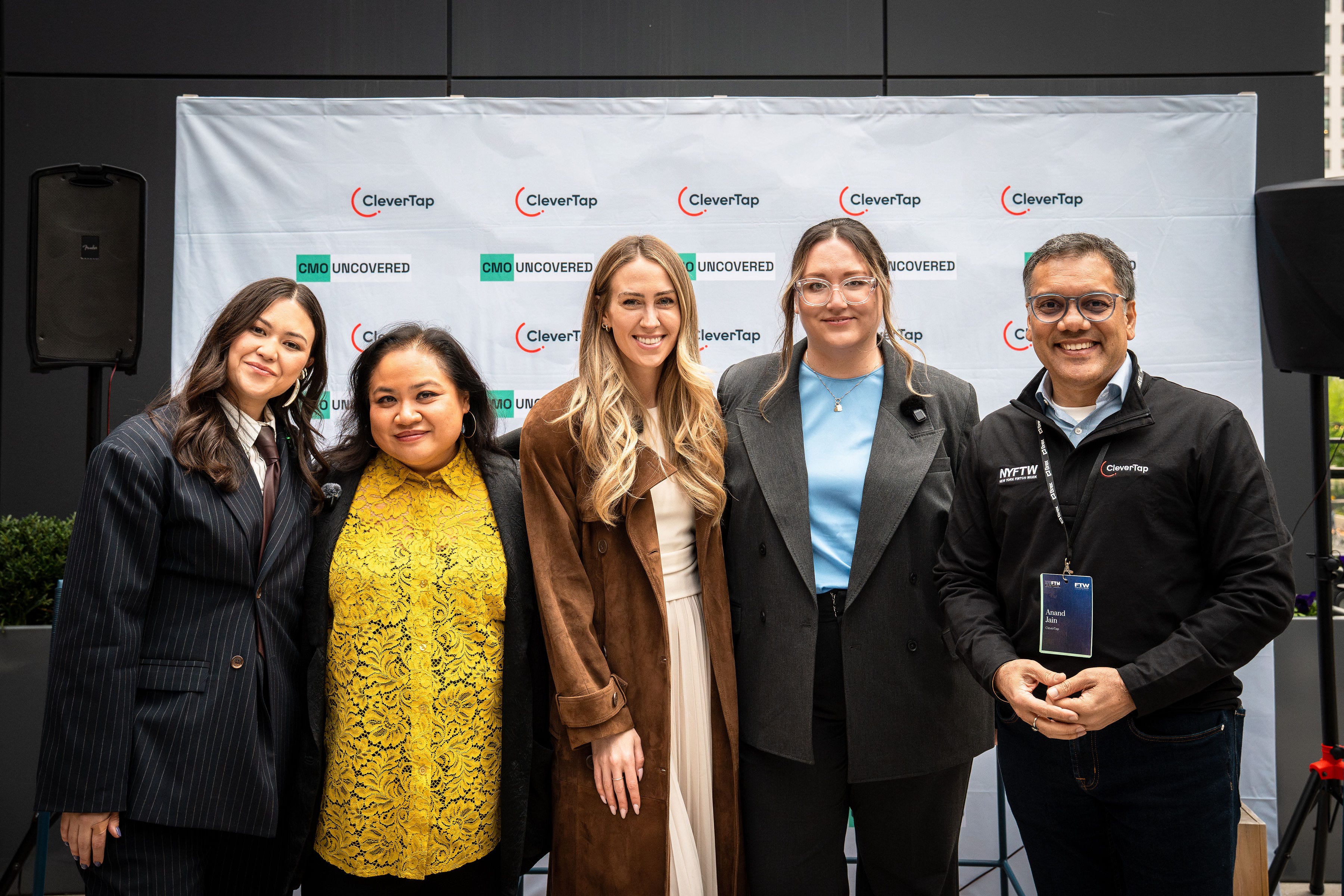
She was one of three marketing leaders on stage at the Big Leap VIP Experience during New York Fintech Week, where CMO Uncovered recorded a live panel conversation sponsored by CleverTap. Nicole Casperson, Founder and CEO of Fintech Is Femme, moderated an ESPN-inspired round robin panel designed by Drew Glover, Co-Founder of Fiat Growth:
5 provocative topics
3 operators
0 rehearsed answers
The panelists: Veronica Mendoza, VP of Growth Marketing at Betterment, an online investment platform making financial advice accessible and affordable. Kathryn Flynn, VP of Marketing at Zip, a buy now, pay later company focused on serving America’s underserved population. And Ashley, the CMO of Prove, a digital identity company that helps businesses verify people are real.
Before the panel kicked off, Anand Jain, Co-Founder of CleverTap, took the stage to mark Big Leap’s second year. “In the world of notifications, emails, everything that you can’t see and touch, we have launched a magazine,” he said, holding up CleverTap’s first print publication to cheers from the crowd.
Your Next Site Visitor Runs on a Large Language Model
The opening topic was blunt: AEO is the new SEO. The panel agreed, then pushed further.
Veronica set the frame. “AEO is not just the new SEO, it’s the new search, sort of wholesale,” she said. “People are using LLMs as their entry point all the time.” Marketers now need to show up in the conversational layer that LLMs pull from: Reddit, review sites, and press. “If you’re not there, you’re just gonna be missing entire swaths of users.”
Kathryn split the challenge in two. Human discovery still works the way it always has: great content, consistency, brand work people talk about. But agent discovery is a different problem. At Zip, her team is preparing for a world where autonomous agents make purchases on behalf of humans. “For us, it starts with governance. It starts with security,” she said, pointing to trust frameworks and identity preservation.
Ashley landed the point with a specific example. Her team at Prove adopted Scrunch, an AI search optimization tool, to monitor how the company appears in LLM-generated responses. One finding caught her off guard.
“Last week I learned that our competitors were being cited more often because they have Wikipedia pages. Now my team has the mandate to go create a Wikipedia page, which I can’t imagine having asked them to do six months ago.”
High-Trust Channels and the 3X Content Play
The second topic tested whether the traditional funnel is dead.
Ashley reframed the question around trust instead of structure. What changed is not that the funnel broke but that low-trust channels cratered. “Some of the low-trust channels, cold outbound, have gotten so bad that we feel comfortable ignoring them completely,” she said. When she joined Prove a year ago, her first two investments were customer marketing and community, then partner marketing. “Whenever we can have a customer speaking on our behalf, we want to create that platform for them to do that.”
Kathryn had the data. Zip launched a customer ambassador program where real customers create content in their own homes, sharing honest takes on why they use the product. “We have seen such strong engagement rates to that content, 2X, 3X what we’re seeing from actor or static,” she said.
Veronica pushed back on calling the funnel dead. “Maybe not necessarily that it’s dead, but that we’re all reckoning with the fact that it was always kind of an oversimplification,” she said. At Betterment, she tracks account-based marketing prospects who move “two steps forward and one step back” through their journeys. The goal is to be present at every stage, not to force people through a linear path. She pointed to Betterment’s B2B campaign built around SpongeBob SquarePants, a nod to CEO Sarah Levy’s history as COO of Nickelodeon.
“B2B customers are not just B2B buyers. It’s important to respect that people could be sitting on their couch at night and see something amusing from one of your B2B solutions.”
Taste, Bravery, and the Sea of Sameness
When every team can generate thousands of assets with AI, the panel agreed: production is no longer the constraint. Differentiation is.
Ashley tied the challenge directly to Prove’s mission. “Authenticity really becomes the moat, and taste is how you build that authenticity,” she said. For an identity company whose entire purpose is helping people prove they are real, operating in a world of AI-generated content carries a specific weight. “We have no choice but to operate by that standard ourselves.”
Kathryn argued that taste extends well beyond campaigns.
“The brand is not just the campaign. The brand is how your product works. It’s their product working every single time someone goes to use it at a critical moment in their day.”
Veronica screens for taste during hiring. What she pushes her teams toward is bravery. “Can you not worry too much about what has worked in the past or looks the same as everything else?” she said. “Let’s take a big swing and learn fast because now we have the luxury of time.”
Don’t Shrink the Team. Multiply It.
The fourth topic pushed back on the narrative that AI-native marketing teams must be smaller.
Ashley cut through the noise immediately. “If your team does not look like five marketers and 100 agents, you’re fine. Normal,” she said. She called out a growing, unspoken pressure. “A lot of marketers are silently sitting in AI shame jail right now because they feel like their team should look different than it does.” Her team at Prove is 25 to 30 people, and she has no plans to reduce it.
“The things that move the needle right now still require humanity.”
Kathryn pushed the conversation to a structural level. “It’s rethinking completely how this team operates,” she said. “What is this team accountable for delivering? And where in that system does the human judgment need to sit?” As AI removes the resource constraint, the real challenge shifts to decision-making: teaching more junior people how to make strategic calls they have never had to make before.
Veronica described the AI-native org as resembling “the scrappy and lean startup marketing orgs of the past,” but with a meaningful upgrade. Marketers can redirect time from execution to strategy. “The question starts to become less of ‘can we get it all done’ and more of ‘are we doing the right things?’”
Attribution Was Never a Perfect Science
The closing topic was the most provocative prompt of the night: is attribution is a lie everyone keeps paying for?
Veronica did not need convincing. “I have always been an attribution skeptic,” she said. She started her career in search marketing at the dawn of pay-per-click, the clearest attribution line possible: last click to purchase. But as she moved up funnel, the clarity disappeared. “If any vendor was promising clarity, it felt very disingenuous to me. It would be based on a set of assumptions that were clearly going to be biased. There was never a perfect science here, and there has just always been a lot of hand-waving, and it was all in the pursuit of credit.”
Her solution: stop chasing perfect attribution and align with finance. “When we can align with our buddies over in FP&A on CAC, on ROAS, it gives you the freedom to play within those constraints and take the swings that you can afford to swing at,” she said. That alignment breeds better cross-team partnership because everyone operates toward one goal instead of fighting over credit.
Kathryn traced the problem back to its origin. “I blame the beginning of digital marketing for this,” she said. “CMOs were finally able to go to their CFO friends and say, ‘Look what we can do now.’ That was really exciting. That probably wasn’t very true then, and it’s certainly not true now.” The answer is not better dashboards. “It’s about unlearning that truth and relearning a new set of truths that are credible across your organization so that there is that collective buy-in.”
The panel also called out the structural incentive problem: media vendors report on the efficacy of what they sell in silos, and when CMOs try to stitch those reports together, the result is what one panelist called “a little bit of a house of cards.”
Glasses Up on the Rooftop
Nicole closed by asking the crowd to raise their glasses. “We went through the round robin. They were honest,” she said, noting with a laugh that the panelists were drinking water.
Across all five topics, every panelist landed in the same place: the tools keep changing, but the decisions that matter, what to prioritize, what to say, and how to earn trust, still belong to people.
Ashley put it most succinctly when describing the new reality of site visitors.
“In a world that runs on AI, the most important visitor that’s landing on your site now is not even human.” The challenge for CMOs is making sure the humans behind the strategy still are.
This season of CMO Uncovered is supported by CleverTap. CleverTap is the world’s leading engagement platform, helping brands build meaningful relationships through data-driven personalization. Powering over 2,000 customers globally, CleverTap’s AI-powered engine processes billions of data points daily to help marketers predict behavior and automate engagement at scale. From onboarding to advocacy, CleverTap provides the infrastructure needed to optimize every stage of the customer journey. For the CMOs building the next generation of iconic brands, CleverTap offers the precision and scale required to win in a crowded market. To learn more, visit clevertap.com.
More from Uncovered Media


