



Rick Galasieski arrived at Talladega prepared to explain Super.com.
The company had become an official savings partner of NASCAR and set up an activation where fans could learn about its products. Rick assumed most visitors would be meeting the brand for the first time. Then people began walking up to the tent, opening the app on their phones, and showing him that they were already members.
He adjusted the conversation. Instead of explaining what Super.com was, he began asking which parts of it they had used. A customer who knew the travel product might not know about cash advances, earnings tools, or credit building. What looked like a broad awareness campaign became a chance to help existing members understand more of the company they had already joined.
Over five years at Super.com, Rick has watched the business move through a series of growth stages that demanded different answers. Travel created acquisition. Membership extended the relationship. A wider set of financial products made retention and cross-selling more pressing. NASCAR entered the picture when Super.com believed familiarity and credibility had become constraints of their own.
Every product is at a different stage
Super.com began as SnapTravel, a company focused on discounted hotel bookings. By the time Rick joined, travel had already become a reliable way to bring customers into the business. He came in to build embedded financial products around that base, including cash advances, credit-building tools, an earnings platform, and a digital wallet.
Rick does not evaluate all of those products through the same set of numbers. He first considers where each one sits in its life cycle. A new product has to prove that customers can be acquired at a workable cost. A product with several years of history faces a different challenge: keeping those customers long enough to support the economics.
Travel has nearly a decade of operating history behind it. Super.com’s cash advance product has been running for about three years, giving Rick a clearer view of acquisition costs, channels, and the levers available when the company wants to increase volume. The newer credit-building product is still establishing those basics after more than a year spent working through compliance and regulatory requirements.
That makes a debate about customer acquisition cost versus lifetime value too simple for Rick. Both matter, but not in the same way at every stage. When Super.com introduced its membership program, the company tested three price points and tracked conversion, retention, customer acquisition cost, lifetime value, and return on ad spend before deciding how to iterate. The metric follows the question the product still needs to answer.
This life cycle view also helps explain why Super.com began spending more heavily on brand. Its performance channels still worked, and the company could continue acquiring customers through travel and other product-specific entry points. Rick believed the larger opportunity required more people to recognize the company and feel comfortable exploring a broader relationship with it.
Brand needs a defined job
Super.com did not choose NASCAR only because Rick likes sports.
The company studied the audience and saw a close match with the customers it already served: everyday Americans trying to save money, stretch their income, or improve their financial position. NASCAR offered reach and credibility with a community that had a strong relationship with the sport and its partners.
That credibility became more useful as Super.com grew beyond the product that first introduced it to customers. A company called SnapTravel could explain discounted hotels, but it could not easily hold travel, cash advances, earnings, credit building, and a membership program under one identity. Super.com hired agencies and consultants, studied customer personas, narrowed a list of possible names, and chose a domain it did not yet own.
The domain purchase was well worth the investment, returning far more than the initial investment. The name works as the company’s identity, website, and message. A billboard can say only Super.com and still tell people where to go. That simplicity became more valuable as the product expanded.
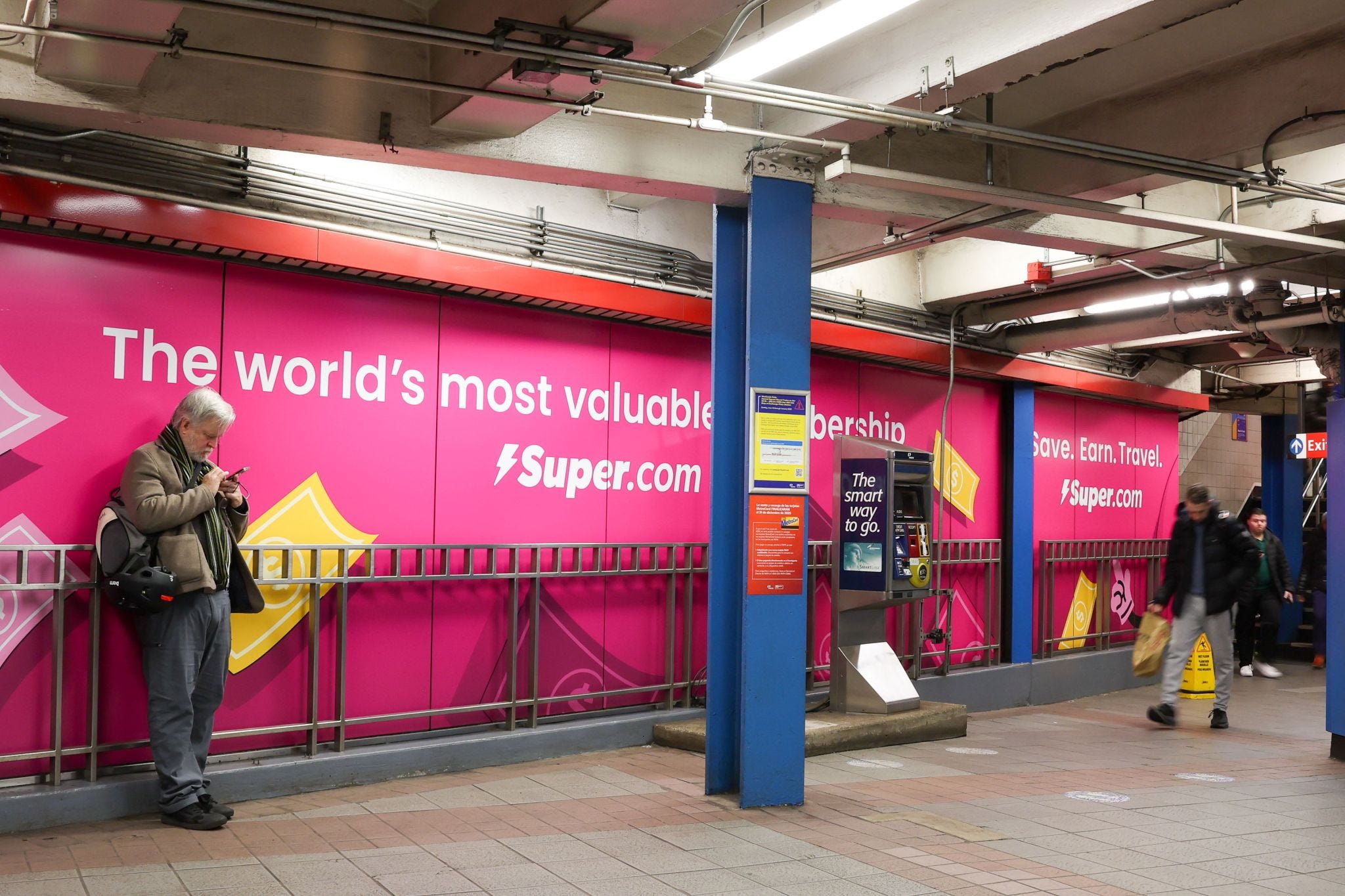
The NASCAR relationship followed similar logic. Super.com had already experimented with airport, subway, and sports advertising, but NASCAR offered a more concentrated customer fit. The partnership also required approval from both sides. NASCAR vetted the company before associating its brand with Super.com, adding another layer of credibility to the arrangement.
At Talladega, Rick found that many fans needed no introduction. Their familiarity did not make the activation unnecessary. It changed what the company could do with the interaction. Once he knew they were members, he could focus on the products they had not yet discovered.
The front door should lead somewhere
Travel remains one of Super.com’s most effective entry points.
A customer looking for a hotel may find Super.com listed beside larger travel platforms at a lower price. During checkout, the company offers the option to join Super Plus for $15 per month and receive an additional 10% off that booking and future hotel reservations. According to Rick, the program is approaching 1 million paid members.
The membership gave Super.com a way to extend the relationship beyond a single trip. It also made the rest of the product ecosystem more consequential. Someone who enters through travel may later use credit building. Someone who arrives through cash advance may need a way to earn additional money. The value of acquisition increasingly depends on whether the company can make the next product relevant.
Super.com recently rebuilt its home page around that question. The company knows which product brought a customer into the ecosystem and uses machine learning to determine what to show next. A customer who arrives through cash advance is more likely to see the earnings platform because the original behavior suggests an immediate need for money. Rick says the first version has already increased engagement and return visits to the home page.
He has also spent years pushing teams to repeat key messages more than they think necessary. A product manager may see a call to action sitting plainly on a page and assume the customer has noticed it. Rick assumes many people have not seen it, understood it, or encountered it at the right moment. That is why the same recommendation may appear through the home page, customer relationship management messages, and other prompts across the experience.
Each interaction is meant to make the path through the product clearer. The membership gives customers a reason to stay, while personalization helps determine what they should see when they return.
Speed needs a feedback loop
Super.com moves quickly, but Rick does not treat speed as evidence that a decision is right.
Early in his career, during the dot-com boom, he and a partner wrote a business plan and raised $2 million within weeks. The company grew to more than 200 employees before closing when the market turned and its burn rate became unsustainable. The experience taught him how easily capital and momentum can hide weak economics.
At Super.com, the operating model shortens the time between an idea and reliable evidence. Teams test pricing, customer flows, ads, and landing pages, then use the results to determine what deserves more investment. Growth employees sit within product teams, while finance, product, and marketing review performance against shared objectives. Rick is wary of marketing metrics that look successful but do not support the product or financial targets above them.
That structure allows the business to move quickly without separating experimentation from accountability. Rick may use instinct to identify where to look, but he expects the data to determine whether the company continues. His role reinforces that discipline. As general manager of financial products and earnings, he owns the profit and loss statement for Super.com’s non-travel businesses, so marketing spend eventually has to connect to revenue, retention, or product adoption.
The company applies the same approach to artificial intelligence. Super.com expects employees to use AI tools, provides internal training, and asks teams to demonstrate agents and workflows during weekly reviews so others can reuse them. Rick now uses Claude, connected to internal analytics systems, to answer some data questions that previously required waiting for an analyst.
The value is the time recovered between seeing a problem and learning whether the proposed answer works. Travel showed Super.com how to acquire customers. Membership gave them a reason to return. Personalization now helps decide what each customer should encounter next.
Rick’s job is to notice when one question has been answered well enough to start asking another.
This season of CMO Uncovered is supported by CleverTap. CleverTap is the world’s leading engagement platform, helping brands build meaningful relationships through data-driven personalization. Powering over 2,000 customers globally, CleverTap’s AI-powered engine processes billions of data points daily to help marketers predict behavior and automate engagement at scale. From onboarding to advocacy, CleverTap provides the infrastructure needed to optimize every stage of the customer journey. For the CMOs building the next generation of iconic brands, CleverTap offers the precision and scale required to win in a crowded market. To learn more, visit clevertap.com.
More from Uncovered Media


